Save energy with sun protection
How modern solutions increase building efficiency

‘Sun protection is essential,’ says Wilhelm Hachtel. As former managing director of MHZ and a long-standing member of five industry associations, he knows what he is talking about. He has been looking into how privacy and sun protection can reduce energy consumption in a meaningful way for many years.
The problem is clear: if we want to continue living comfortably in our own homes in the future, we need to act now. Summers are starting earlier, ending later and becoming hotter. The number of days with temperatures above 30 degrees is also rising steadily in Central Europe. In the podcast episode with ‘der Höfliche und der [BAU]stein’ (the polite one and the building block), Wilhelm Hachtel explains how heat is generated in rooms and highlights options for counteracting rising temperatures.
Why do rooms get so extremely hot in summer?

The angle of the sun is decisive here. When sunlight hits a window at a right angle, a particularly large amount of energy enters the building. Depending on the time of day and season, certain windows are particularly affected, for example east-facing windows in the morning or south-facing windows in the midday sun. In summer, the angle of incidence of sunlight is much flatter, which means that larger surfaces are directly exposed to the sun. This causes rooms to heat up more quickly. The building environment is also a decisive factor – are there any surrounding buildings whose facades reflect sunlight and thus increase the amount of energy entering the building?
How can this energy be measured?
Two physical parameters play a key role in assessing the energy efficiency of windows:
- The total energy transmittance (g value) measures how much solar energy enters the room.
- The u-value (heat transfer coefficient) indicates how much heat energy is lost to the outside.
A typical double-glazed window has a g-value of around 0.6. This means that 60% of the solar energy is transmitted. In architecture, the g-tot value is also calculated. This represents the total energy transmittance taking into account sun protection. Effective external sun protection can reduce the g-value to as low as 0.1.
How can this be implemented in practice with sun protection?

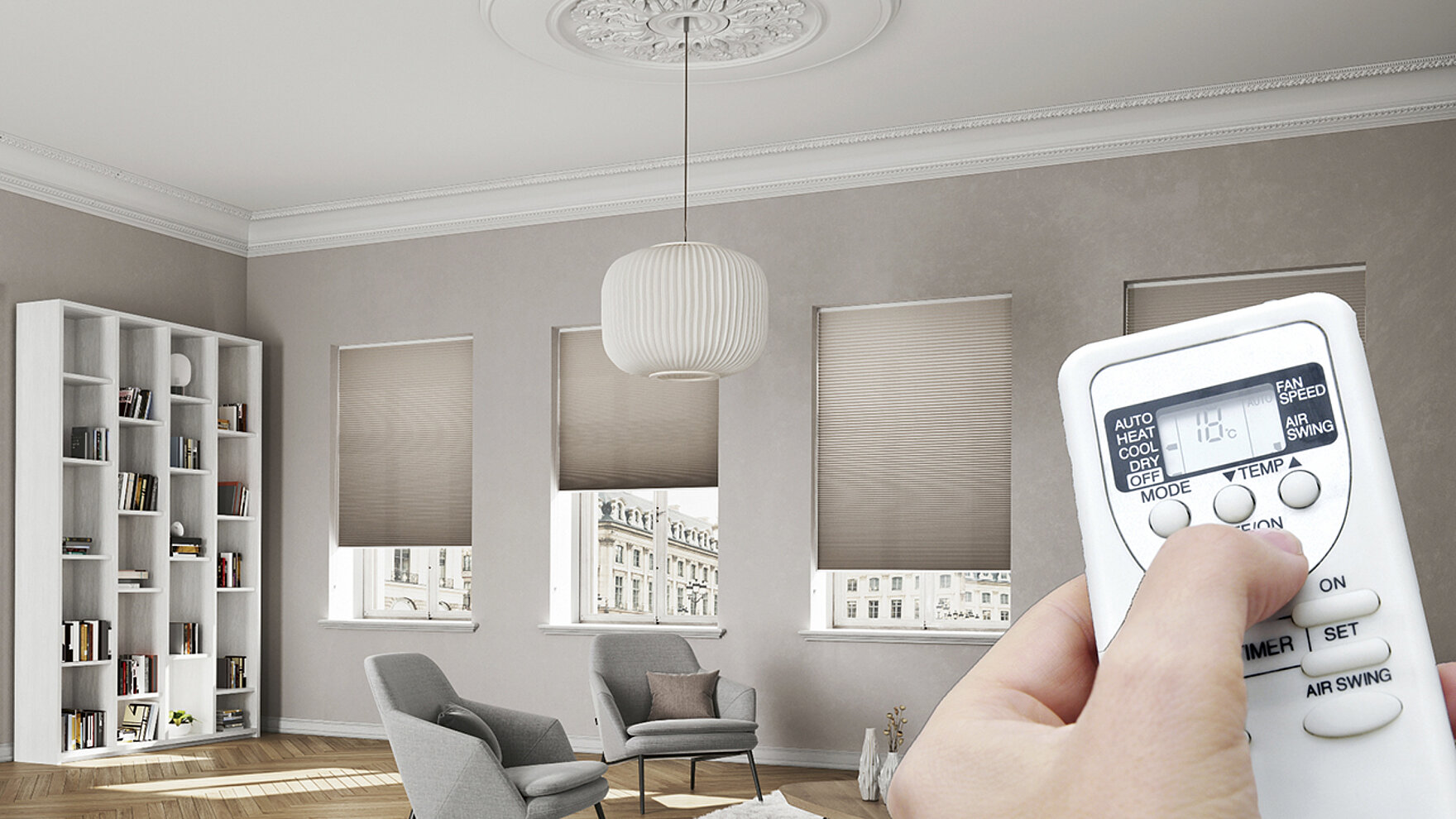
An optimal solution can only be achieved through a combination of external and internal sun protection. External systems such as external roller blinds or vertical awnings block incident sunlight before it reaches the window pane. Internal products such as honeycomb pleated blinds support heat storage in winter and offer glare protection at the same time. Studies show that these measures can save up to a third of heating energy in winter.
Don't sunglasses also help against the heat in summer?
Sun protection glazing can achieve total energy transmittance values of 0.2 to 0.3. However, this alone is not sufficient. Rooms with computer workstations in particular require additional glare protection. In winter, these types of glass also block the warming sunlight that should help to heat the building.
External sun protection is therefore the better solution. This is heated by sunlight, the warm air rises and is directed away from the building.
What is an appropriate room temperature in summer?

According to European standard DIN EN 14500, the room temperature in residential buildings should not exceed 26°C.
However, a study by the engineering firm Hauser (IBH4) shows that without sun protection, this value is already exceeded on more than 60 days per year. By 2045, they predict that there will be more than 100 such days.
Conventional sun protection will no longer be sufficient to protect against overheating in the future. As a result, summer will become a burden even in modern new buildings. Air conditioning systems are often considered a solution, but they are very energy-intensive and cause high electricity costs. For example, if you want to keep a south-facing room at a constant 24°C, you have to run the air conditioning almost continuously.
Optimal results can only be achieved with additional sun protection. This means that most of the solar energy is already intercepted and the air conditioning only needs to provide selective support.
The global trend is worrying. In countries such as India, the average annual temperature is predicted to reach 36°C by 2050. In China, energy consumption has tripled over the last ten years. The consequences of climate change have long been felt in Europe too. This makes it all the more important to prepare buildings for these conditions with sustainable, efficient and controllable solutions.
What solution does this offer me?
Modern privacy and sun protection systems help make buildings more resistant to extreme weather conditions. However, a single system is not enough to respond sensibly, efficiently and regularly to changing situations. The solution for achieving optimum efficiency lies in internally and externally installed, intelligently controlled systems. These should be sensor- or time-controlled and take geographical data into account.
MHZ offers solutions that save energy, increase comfort and improve the indoor climate at the same time. As a resident, you are making an active contribution to combating global warming.